1959
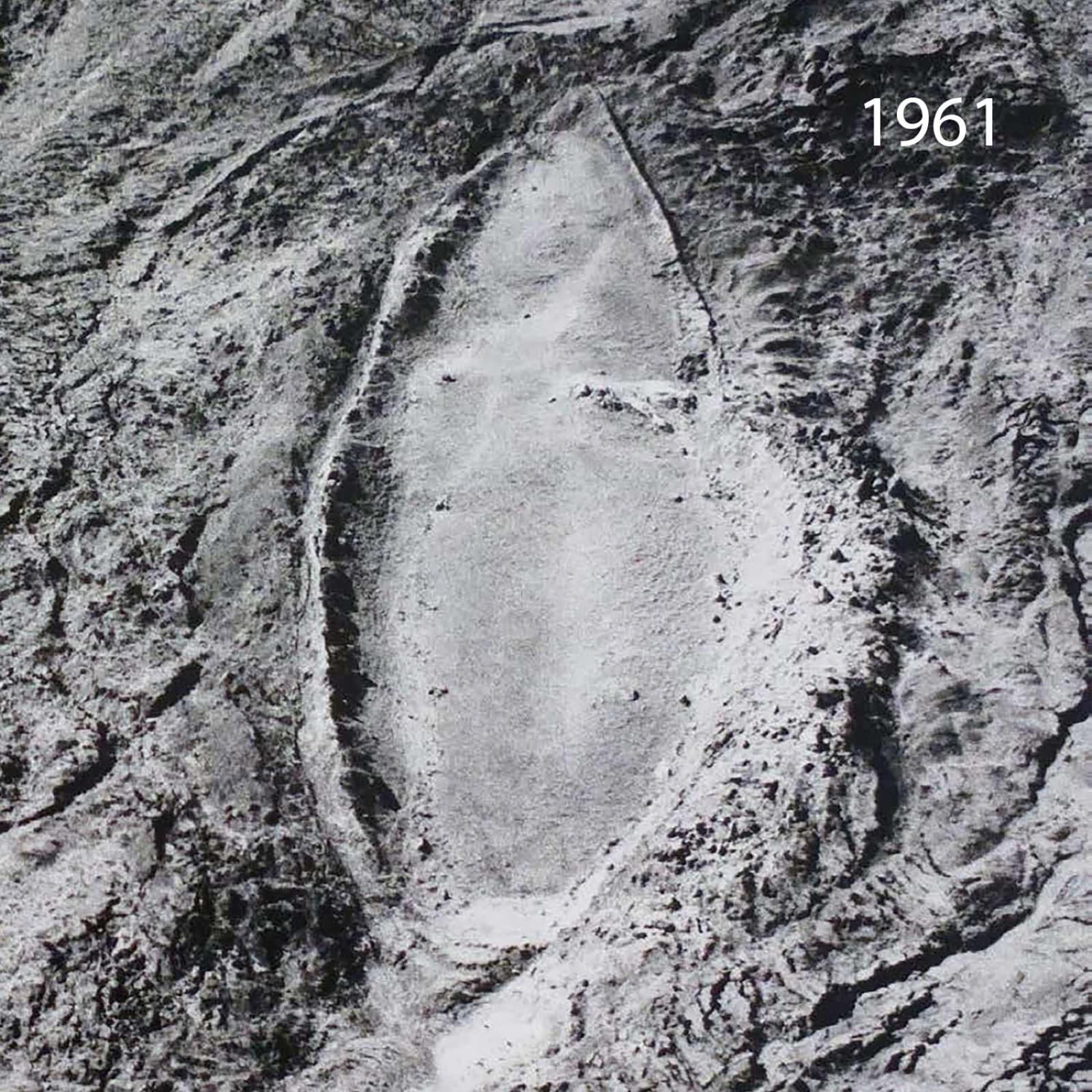
Turkish Army captain İlhan Durupınar identifies a large boat-shaped formation in aerial reconnaissance photographs of eastern Turkey, roughly 18 miles south of Mount Ararat. The formation measures about 157 meters — close to the 300-cubit length given in Genesis 6.
1960
A joint American-Turkish team travels to the site to investigate. The technology available at the time limits what can be learned about what lies beneath the surface.
1977
Researcher Ron Wyatt starts systematic investigations at the site — metal-detector surveys, surface measurements, and specimen collection — that continue over the following two decades.
1984
Wyatt photographs inscriptions on the boundary markers along the Turkish-Iranian border, material later revisited by the Noah’s Ark Scans team.
1987–1988
Salih Bayraktutan (Atatürk University) and John Baumgardner (Los Alamos) produce a geological report, then drill four core holes across the formation between July 28 and August 7, 1988 — the first direct subsurface samples.
1996
Lorence Collins and David Fasold publish a widely cited paper arguing the formation is a natural geological structure — a position the project continues to test against new data.
2014–2015
Electrical Resistivity Tomography (ERT) scanning begins, marking the start of the modern instrument-driven phase of research at the site.
2019
Andrew Jones leads high-resolution drone photography and Ground Penetrating Radar surveys, producing imaging that reveals linear structures and right angles below the surface.
2021
A government-backed scientific survey deploys ERT and GPR across the formation, filmed by the History Channel. The ToPa 3D survey adds further subsurface data.
2023
Findings are presented at the 7th International Mount Ararat & Noah’s Ark Symposium, including the report on the Turkish-Iranian border inscriptions.
2024
Laboratory analysis of 2024 soil samples shows roughly three times more organic material inside the formation than in control samples taken outside it.
Next
The next phase moves from remote sensing to targeted core drilling at GPR/ERT anomalies, with radiocarbon dating and possible camera inspection of subsurface voids.
Explore the data behind this history on the evidence and research papers pages.
Help fund the next phase of research at the Durupınar site.